
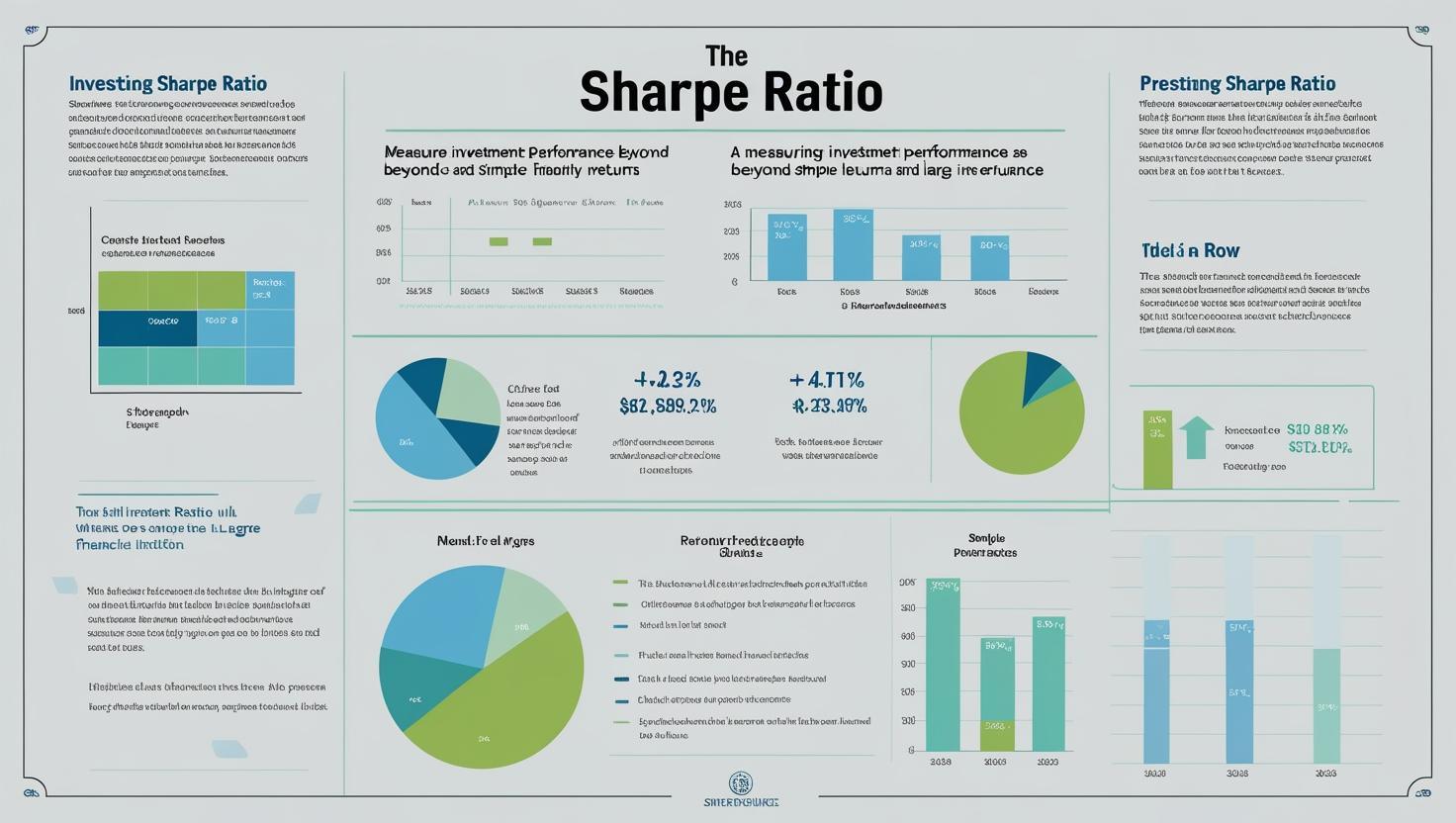
Why Go Beyond Simple Returns?
Portfolio A: The Rollercoaster
This portfolio achieved a 10% return, but with high volatility. The wild swings can be stressful and lead to poor decisions.
Portfolio B: The Steady Climb
Also returning 10%, this portfolio grew smoothly. It represents a more efficient, less risky path to the same outcome.
Both portfolios had the same 10% return, but Portfolio B provided a much better risk-adjusted return. This is the core concept the Sharpe Ratio helps us quantify.
What is the Sharpe Ratio?
At its core, the Sharpe Ratio measures the performance of an investment compared to a risk-free asset, after adjusting for its risk. It’s the “quality score” for your returns.
Sharpe Ratio = (Rp – Rf) / σp
Rp : Return of Portfolio
The average return of the investment over a period.
Rf : Risk-Free Rate
The return from a no-risk investment, like a government bond.
σp : Standard Deviation
The investment’s volatility. Higher means more risk.
Why It Matters to Big Institutions & Hedge Funds
For multi-billion dollar funds, the Sharpe Ratio is a foundational metric for portfolio construction, manager evaluation, and efficient capital allocation. It helps them move from chasing high returns to seeking the most efficient, risk-adjusted performance.
Strategy & Manager Evaluation
Institutions allocate more capital to managers and strategies with higher Sharpe Ratios, rewarding efficient performance over reckless returns.
Asset Class Comparison
The ratio allows for an apples-to-apples comparison of different asset classes based on their risk-adjusted returns.
Portfolio Optimization: The Efficient Frontier
This scatter plot shows various assets by their risk (volatility) and return. The goal is to build a portfolio on the “Efficient Frontier” – the optimal curve that offers the highest expected return for a given level of risk. The Sharpe Ratio is key to finding the tangent portfolio on this curve.
How to Interpret the Sharpe Ratio
< 1.0
Poor
Return does not justify the risk taken.
1.0-1.99
Good
A reasonable return for the risk assumed.
≥ 2.0
Excellent
Indicates strong risk-adjusted performance.
≥ 3.0
Exceptional
Superior returns for minimal relative risk.
For the titans of finance – the big institutions and hedge funds managing colossal sums – the Sharpe Ratio is not just a theoretical construct; it’s a bedrock principle. It’s their compass for constructing resilient portfolios, evaluating the true skill of their managers, and allocating capital with surgical precision. In a world where even a fractional improvement in risk-adjusted returns can mean billions, the Sharpe Ratio ensures that every dollar is not just working hard, but working smart. By embracing this metric, you too can begin to unlock a deeper, more sophisticated understanding of investment performance, making choices that are not just profitable, but strategically sound.


Leave a Reply