
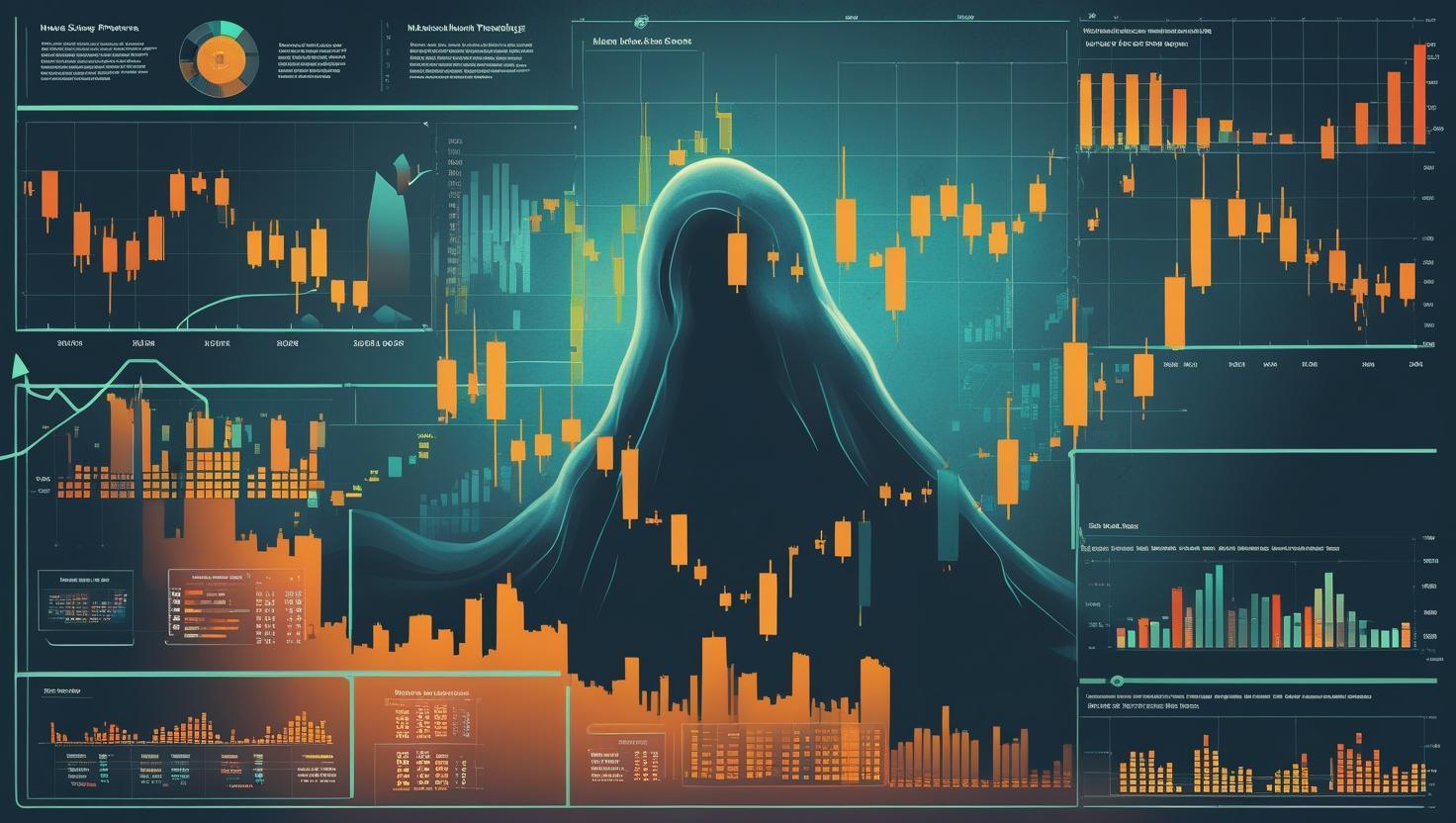
What Are “Ghost Patterns”?
In the complex world of **financial markets**, **Ghost Patterns** are subtle, non-obvious recurring behaviors or relationships that are typically obscured by market noise. They aren’t easily visible on standard charts or through simple technical analysis.
Think of them as a faint, underlying melody hidden within a chaotic symphony of market data. Uncovering these **hidden patterns** requires advanced techniques, but the payoff can be a significant trading edge for **smarter trading**.
The chart above shows a ‘noisy’ market movement. Can you spot the subtle, recurring pattern (the ‘ghost’) beneath the surface? Traditional analysis often misses these **hidden market patterns**.
Why Are They So Hard to Spot?
**Market ghosts** are elusive for several reasons, often requiring more than the human eye or basic algorithms can discern:
Market Noise
Random fluctuations overwhelm true signals, masking **hidden patterns**.
Complex Interactions
**Ghost patterns** emerge from many variables acting together.
Adaptive Markets
These **hidden patterns** constantly evolve, making them hard to track.
Data Volume
Sheer amount of **financial market** data makes manual analysis impossible for **ghost patterns**.
The Tools to Unmask Ghosts
Uncovering these **hidden patterns** (or **ghost patterns**) requires a combination of sophisticated computational power and intelligent analytical techniques for truly **smarter trading** insights:
Machine Learning (ML)
ML algorithms excel at finding non-linear relationships and subtle anomalies in massive datasets to uncover **hidden patterns**.
Advanced Statistical Analysis
Techniques like Fourier analysis and time-series modeling can decompose **financial market** data to reveal underlying periodicities or trends.
Big Data & HPC
The sheer volume and velocity of **financial market** data demand robust infrastructure to analyze information quickly and exploit **ghost patterns**.
Where Might They Reside?
**Ghost patterns** can appear in various forms and across different layers of the **financial market** ecosystem:
Inter-Market Relationships
Subtle lead-lag effects between seemingly unrelated assets (e.g., bond yields predicting equity movements, or commodity prices influencing currency pairs) can be **hidden patterns**.
Market Microstructure Effects
Tiny, short-lived inefficiencies in the order book, order flow imbalances, or liquidity dynamics that sophisticated algorithms can exploit as **ghost patterns**.
Behavioral Biases & Market Sentiment
Human psychological biases can create predictable (though often subtle) **hidden patterns** in how markets react to news, fear, or greed, especially over specific time horizons.
This chart conceptualizes how a ‘ghost pattern’ (dotted line) might emerge from collective investor sentiment, influencing prices in a subtle, recurring way.
The “Edge” of Ghost Patterns: Smarter Trading
Unmasking these **hidden patterns** provides a crucial advantage for **smarter trading**:
- **Predictive Power:** Even a slight statistical edge derived from **ghost patterns** can lead to significant cumulative profits over many trades.
- **Diversification:** **Ghost patterns** often offer low correlation with traditional strategies, improving portfolio diversification.
- **Risk Reduction:** Understanding subtle **financial market** dynamics can help anticipate potential risks and optimize trading strategies to minimize exposure.
- **Alpha Generation:** The holy grail for quants – generating unique, uncorrelated returns that outperform the market by leveraging **hidden patterns**.

Leave a Reply