
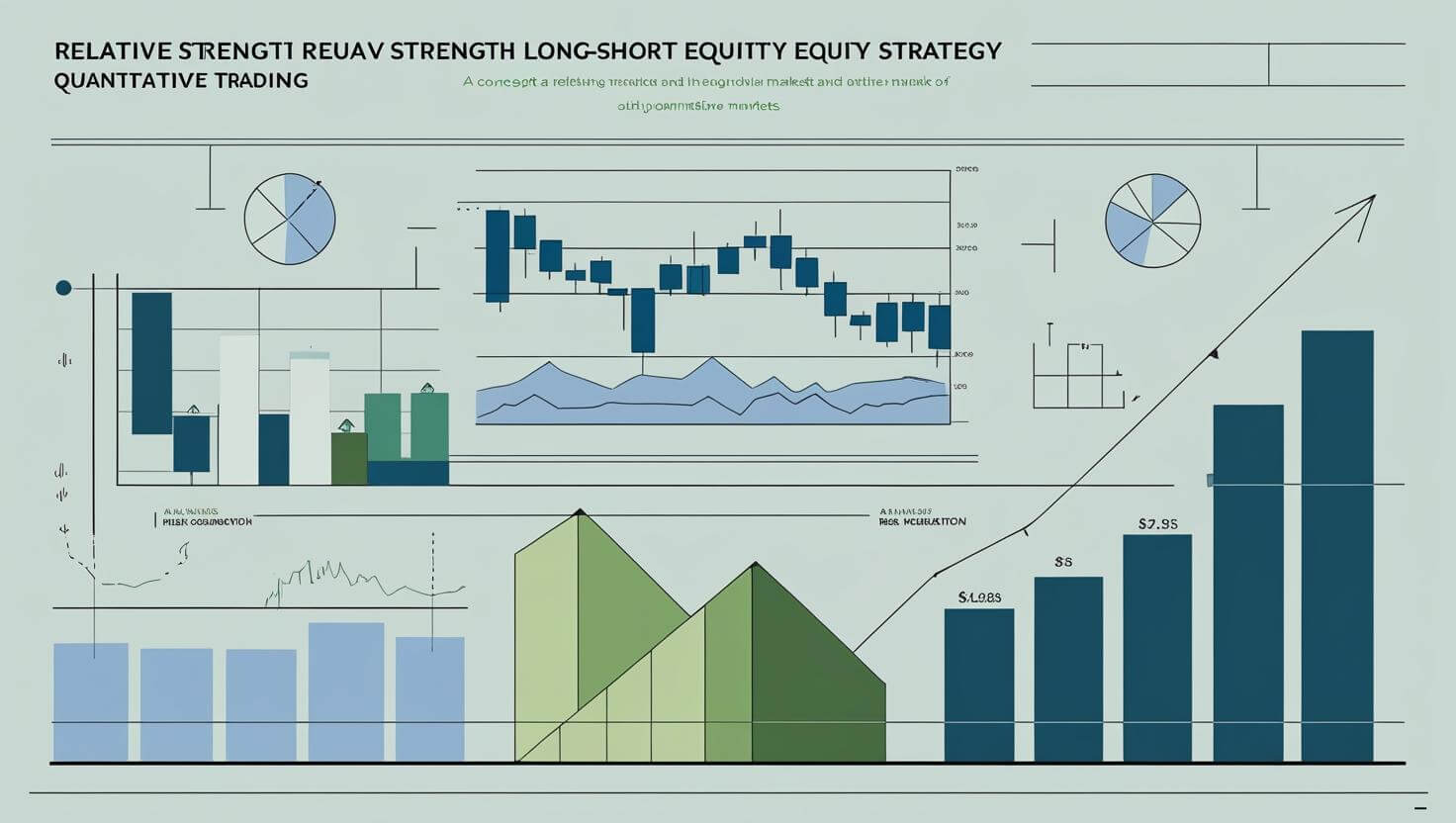
Relative Strength Long-Short Equity Strategy: Unlock Alpha in Quantitative Trading & Momentum Investing
Harnessing **Momentum Investing** and **Quantitative Trading** to Generate **Alpha** & **Outperformance** Beyond Market Movements. Explore **Long-Short Portfolio** and **Hedge Fund Strategies**.
Relative Strength: The Core Concept of Momentum Investing
**Relative Strength**, a key **momentum investing** concept, posits that **past winners tend to keep winning, and past losers tend to keep losing.** **Hedge funds** and **quantitative trading** strategies leverage this persistence to identify **alpha generation** opportunities for **market outperformance**.
Strategy Mechanics: Building a Long-Short Equity Portfolio
Inspired by Mebane T. Faber’s seminal research, this **quantitative trading strategy** systematically identifies “winners” for **long positions** and “losers” for **short positions**, forming a robust **long-short equity portfolio** for **alpha generation** and **risk management**.
1. Define Universe
Start with a fixed universe (e.g., 10 US Equity Industry Sectors) for **stock selection** and **market outperformance**.
2. Lookback Period
Calculate average trailing total returns over a combination of periods (1, 3, 6, 9, 12 months) for **momentum trading**.
3. Monthly Ranking
Rank all sectors from best to worst performing based on **Relative Strength Strategy** for **algorithmic trading** decisions.
4. Rebalance & Trade
Rebalance monthly. Buy top sectors (**long positions**), short bottom sectors (**short positions**) for **market outperformance**.
Long & Short Position Identification for Stock Selection
Long Candidates (The “Stars”)
**Strategy:** Go long (buy) an equal dollar amount in the **top 2-3 sectors** from the monthly ranking for optimal **stock selection** and **alpha generation**.
- **Objective:** Capitalize on continued positive **momentum**.
- **Example:** If Technology and Consumer Non-Durables are the top 2, you buy them.
Short Candidates (The “Dogs”)
**Strategy:** Go short (sell borrowed shares of) an equal dollar amount in the **bottom 2-3 sectors** from the monthly ranking for strategic **stock selection** and **risk management**.
- **Objective:** Profit from continued negative **momentum**.
- **Example:** If Utilities and Telecom are the bottom 2, you short them.
Dollar Neutrality: Balancing the Portfolio for Alpha Generation
Aim for **equal dollar value in long and short positions**. This minimizes exposure to overall market swings, allowing **relative performance** to drive **alpha generation** and enhance **risk management**.
Why This Long-Short Equity Portfolio Aims for High Alpha Returns
This **long-short equity portfolio** adaptation targets **alpha generation** by exploiting distinct **momentum investing** market dynamics, crucial for **quantitative trading** and **hedge fund strategy** for **market outperformance**.
Exploiting Momentum
Capitalizes on the persistence of both positive and negative **momentum** for **algorithmic trading**.
Reduced Beta Exposure
**Long-short positions** minimize exposure to broad market movements, focusing on **relative performance** for effective **risk management**.
Systematic & Objective
Rules-based **quantitative trading** approach reduces emotional bias in **stock selection** and trading decisions for **smarter trading**.
Historical Performance & Results (Faber, 2010) – Backtesting & Outperformance
Mebane T. Faber’s research (2010) on US equity sectors (1928-2009) consistently showed significant **outperformance** and improved **risk-adjusted returns** for **Relative Strength Strategies**, particularly for the combined lookback period through rigorous **backtesting**.
- **Outperformance:** **Relative strength portfolios** outperformed a buy-and-hold benchmark in approximately **70% of all years** (Faber, 2010, p. 9). This highlights the **edge** of **momentum trading**.
- **Alpha Generation:** Estimated **300-600 basis points of outperformance** per year (Faber, 2010, p. 9). A testament to effective **hedge fund strategies**.
- **Risk-Adjusted Returns:** The combined 1, 3, 6, 9, 12-month average strategy (Top 2) achieved a Sharpe Ratio of **0.58** vs. 0.35 for Equal-Weight Buy & Hold (Faber, 2010, p. 9, Exhibit 4.6). Demonstrates superior **risk management**.


Leave a Reply