This plan is designed for developers who want to learn Rust specifically for low-latency and high-performance applications like algorithmic trading. The focus is on concepts essential for speed, safety, and concurrent data handling.
Phase 1: Foundational Rust (The Essentials)
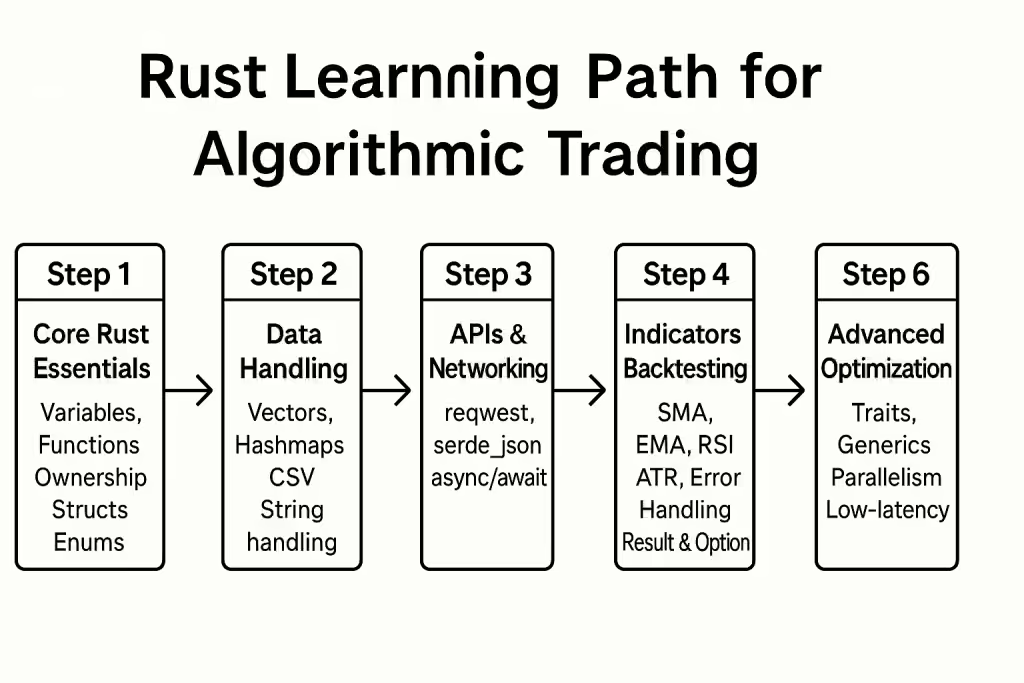
This phase covers the unique core concepts of Rust that make it fast and safe. Understanding these is non-negotiable.
1. The Basics
- Installation & Toolchain: Get
rustupand learn aboutcargo, Rust’s build system and package manager. - Hello, World! & Syntax: Get comfortable with basic syntax, functions, and control flow.
- Data Types: Primitives (
i32,f64,bool, etc.), tuples, and arrays.
2. Ownership, Borrowing, and Lifetimes
This is the heart of Rust’s safety model and is crucial for high performance.
- Ownership: Understanding how data is owned and moved. This prevents memory leaks and data races at compile time.
- Borrowing: Learning how to lend references (
&) to data without taking ownership. - Lifetimes: Understanding how the compiler ensures references are always valid.
3. Essential Data Structures
- Vectors & Strings: The standard, growable array (
Vec) and string types (String,&str). - Hash Maps: Fast key-value lookups for storing market data.
- Structs & Enums: Creating custom data types to model trading concepts like
Order,Tick, orMarketData.
4. Robust Error Handling
ResultandOption: Learn to handle success and failure explicitly without exceptions. This is critical for reliable trading systems.- The
?operator: A convenient way to propagate errors.
Phase 2: Performance and Low-Latency (The Algo trading Edge)
This phase dives into the features that give Rust its performance advantage, which is vital for trading.
5. Memory Management
- Stack vs. Heap: A refresher on where data lives and why it matters for performance.
- Zero-Cost Abstractions: Understanding how Rust’s abstractions (like iterators) compile down to efficient machine code.
6. Low-Level Control
- The
unsafeKeyword: Learn when and how to useunsafeto bypass Rust’s safety guarantees for extreme performance, but always with caution. This is for direct memory manipulation, which can be useful for working with raw data streams. - Foreign Function Interface (FFI): Interfacing with C/C++ libraries. This is useful for connecting to existing trading APIs that are often C-based.
Phase 3: Concurrency and Networking (The Real-Time Engine)
Building a trading system requires handling multiple simultaneous tasks and real-time data feeds.
7. Asynchronous Programming
async/await: The modern, idiomatic way to handle non-blocking I/O in Rust. This is essential for building high-throughput market data handlers.- Tokio Crate: The industry-standard async runtime for Rust. This will be your workhorse for networking and concurrency.
8. Multi-threading
- Threads: How to spawn and manage threads for parallel computations.
- Channels: Using channels for safe communication between threads. This is how you’ll pass messages from a market data thread to an order management thread without data races.
Phase 4: Practical Application
This is where you’ll apply what you’ve learned.
9. Core Libraries (Crates) for Trading
tokio: For all asynchronous I/O and networking.reqwest: For making HTTP requests (e.g., to REST APIs).serde: For serializing and deserializing data (e.g., JSON from an API).polars: A fast data analysis library for backtesting and signal generation.chrono: For handling timestamps and dates, which is critical for time series data.websocketsortokio-tungstenite: For real-time data feeds.
10. Hands-on Project
- Project 1: Simple WebSocket Client: Build a client that connects to a public exchange’s WebSocket API, receives real-time market data, and prints it.
- Project 2: Basic Trading Strategy: Implement a simple moving average crossover strategy on historical data using
polarsand simulate trades. - Project 3: Full-Fledged Bot (Optional): Combine the skills from previous projects to build a simple bot that fetches data, executes a strategy, and sends orders to a mock exchange.

Leave a Reply