
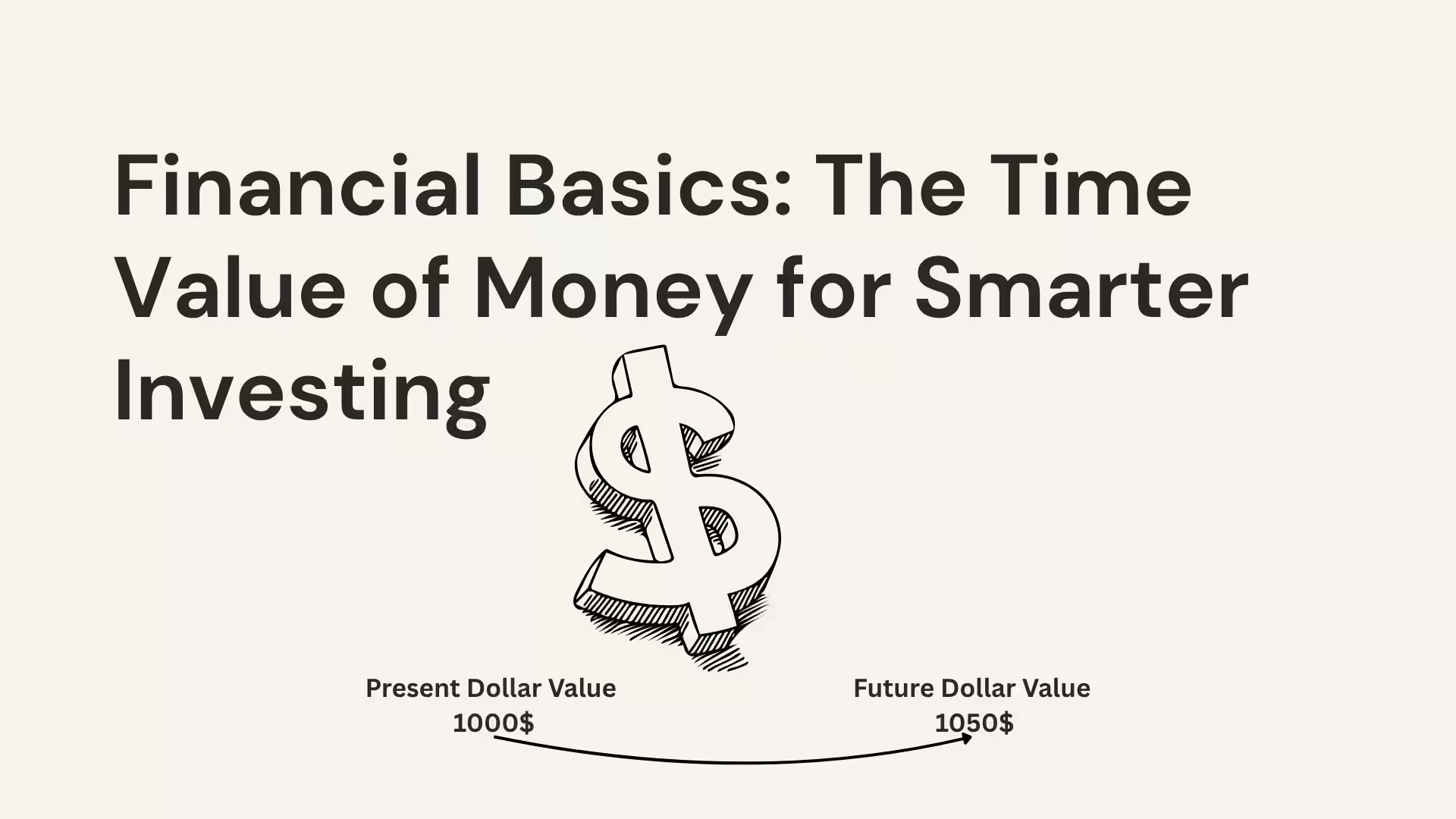
Imagine you’re offered a choice: receive $1,000 today or $1,000 one year from now. Which would you choose? For most people, the answer is simple: take the money today. This seemingly obvious decision is at the heart of one of the most fundamental concepts in finance: the Time Value of Money (TVM).
For beginners in investing, understanding TVM is not just an academic exercise—it’s a critical tool for making smarter financial decisions. This article will demystify TVM, explaining why a dollar today is worth more than a dollar tomorrow and how this principle is the foundation for everything from personal savings to major investment decisions. Get ready to unlock the secret to compounding and take control of your financial future.
What is the Time Value of Money?
The Time Value of Money (TVM) is a core financial principle that states a sum of money is worth more now than the same sum will be at a future date. This is due to a few key reasons:
- Earning Potential: Money available today can be invested to earn a return, such as interest or capital gains. This compounding growth means your money can make more money for you over time.
- Inflation: The purchasing power of money erodes over time. A dollar today can buy more goods and services than it can a year from now. Your investments must grow faster than the rate of inflation just to maintain their value.
- Uncertainty: The future is unpredictable. Receiving money today eliminates the risk that something might happen to it before you receive it later.
The Two Core Components of TVM
TVM is best understood through two core calculations that help you compare the value of money at different points in time:
- Future Value (FV): This answers the question, “What will my money be worth in the future?”
- Concept: Future Value shows how much an initial sum of money (Present Value) will grow over a specific period, assuming a certain interest or return rate.
- Use Case: Perfect for planning. For example, calculating how much your retirement savings will be worth in 20 years.
- Present Value (PV): This answers the question, “What is the future money worth to me today?”
- Concept: Present Value is the current worth of a future sum of money. It helps you “discount” future cash flows to their value in today’s dollars, accounting for the earning potential you’re giving up and the effects of inflation.
- Use Case: Essential for comparing investments. For example, if one investment promises you $1,100 in one year and another offers $1,050 in six months, calculating the Present Value of both helps you make an an apples-to-apples comparison today.
The Simple Formulae
While there are complex variations, the basic formulas for a single lump sum are:
Future Value Formula
FV=PV×(1+r)n
Present Value Formula
PV=(1+r)nFV
Where:
- FV = Future Value
- PV = Present Value
- r = Interest or discount rate (per period)
- n = Number of periods (e.g., years, months)
Practical Examples of TVM in Action
Let’s apply these formulas to real-world scenarios to make the concepts clear.
Calculating Future Value (FV):
- Scenario: You have $1,000 today and you invest it in a savings account that earns a simple 5% annual interest. How much will it be worth in 3 years?
- Calculation:
- PV = $1,000
- r = 0.05 (5%)
- n = 3 years
- FV=$1,000×(1+0.05)3
- FV=$1,000×(1.157625)
- FV=$1,157.63
- Conclusion: Your initial $1,000 will be worth $1,157.63 in three years. This is a simple example of the power of compounding.
Calculating Present Value (PV):
- Scenario: Someone offers to give you a payment of $1,200 in 2 years. If you could earn an average of 6% per year on your investments, what is that future payment worth to you today?
- Calculation:
- FV = $1,200
- r = 0.06 (6%)
- n = 2 years
- PV=(1+0.06)2$1,200
- PV=1.1236$1,200
- PV=$1,068.00
- Conclusion: The promise of $1,200 in two years is only worth $1,068 to you in today’s money. This is the amount you would need to invest today at 6% to have $1,200 in two years.
Why is TVM an Essential Tool for Beginners?
Understanding the Time Value of Money is a crucial discipline for several reasons:
- Smarter Investing Decisions: TVM is the foundation of modern investment analysis. It empowers you to compare different investment options, evaluate the real cost of a loan, and determine if an investment’s future returns justify its current price.
- Unlocking the Power of Compounding: By understanding that your money can grow exponentially over time, TVM teaches you the importance of starting to save and invest early. A small amount invested today is far more valuable than a larger amount invested 10 years from now.
- Strategic Financial Planning: It allows you to set realistic financial goals. Whether you’re saving for a down payment on a house or planning for retirement, TVM helps you calculate exactly how much you need to set aside today to meet those future goals.
- A Counter to Inflation: TVM serves as a constant reminder that if your money isn’t growing at a rate faster than inflation, you are effectively losing purchasing power over time.
In conclusion, the Time Value of Money is not just a theory; it’s a practical, everyday principle that guides sound financial decisions. By mastering this core concept, beginners in finance and investing gain a powerful tool for strategic planning, disciplined saving, and building a more prosperous financial future.



Leave a Reply