
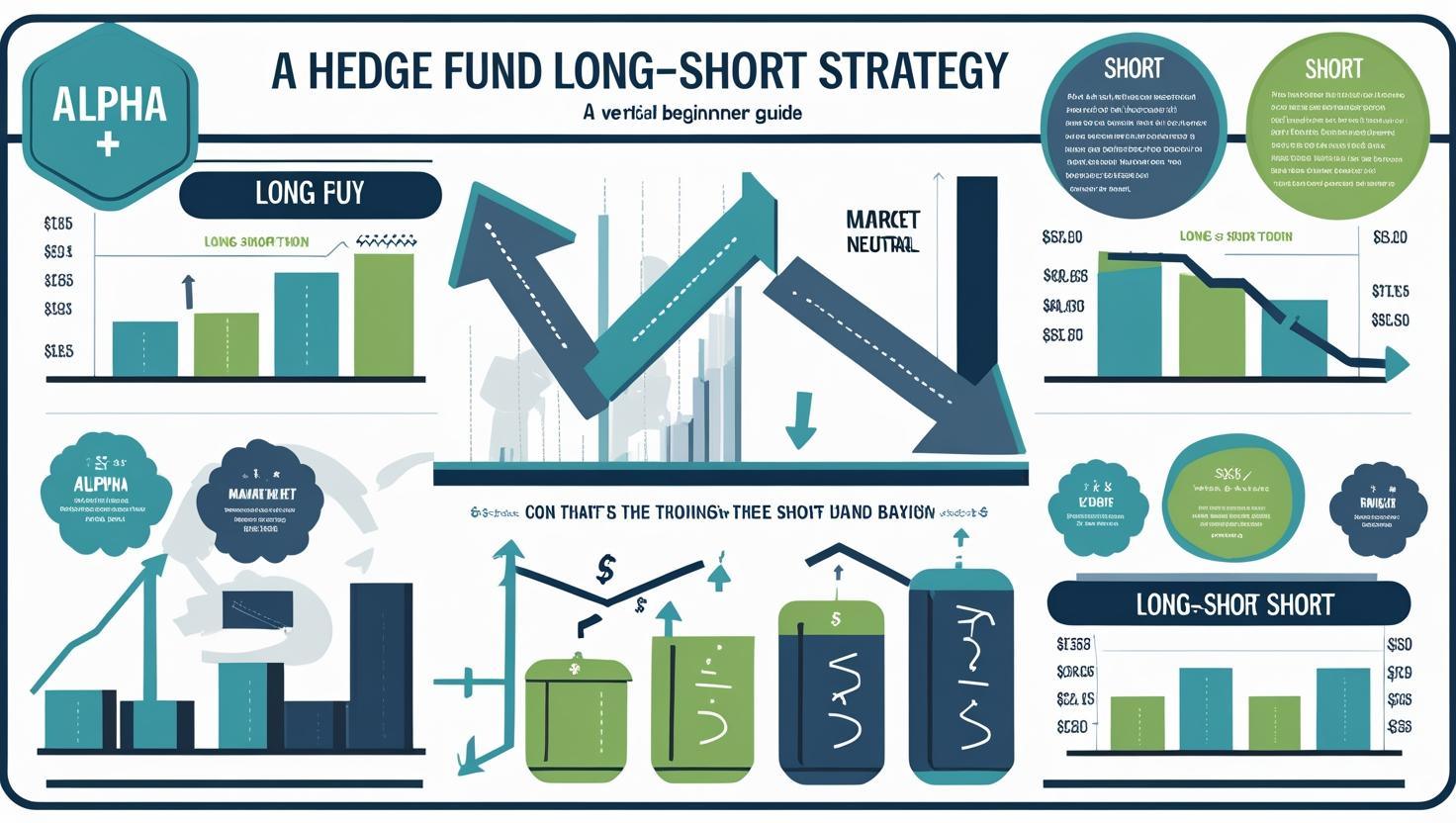
What is a Hedge Fund? (Simplified)
Flexible Investing
Unlike traditional mutual funds, **hedge funds** have significant flexibility to pursue absolute returns, regardless of market direction. They can employ a wide range of strategies and use more complex tools.
Go Long (Buy)
Go Short (Sell)
Use Leverage
Diverse Assets
Introducing the Long-Short Strategy
The **Long-Short Strategy** is a core **hedge fund strategy** that involves simultaneously betting on some assets to rise and others to fall. The goal is to profit from *relative performance*.
Going Long (Buy)
Purchase assets (e.g., stocks) expected to **outperform** the market or peers.
Going Short (Sell)
Sell borrowed assets (e.g., stocks) expected to **underperform** the market or peers.
Why Use Long-Short? Generating Alpha & Market Neutrality
Generating “Alpha” ($\alpha$)
Alpha is the excess return generated by a manager’s skill, independent of overall market movements. By correctly picking outperformers (longs) and underperformers (shorts), the strategy aims to capture this unique return.
Alpha = Portfolio Return – Benchmark Return
Market Neutrality (Reduced Beta)
The strategy aims to minimize its sensitivity to overall market movements (its “beta” exposure). This allows the fund to potentially profit whether the market goes up, down, or sideways, focusing on relative performance.
How the Strategy Works in Detail
1. Identifying Long Candidates
**Look for Outperformers:** Strong fundamentals (earnings, growth), positive catalysts, favorable quantitative signals.
2. Identifying Short Candidates
**Look for Underperformers:** Weakening fundamentals (declining sales, high debt), negative catalysts, overvaluation relative to peers, or even fraud.
3. The Pairing (Achieving Neutrality)
Combine longs and shorts to balance market exposure:
- **Sector/Industry Neutral:** Long & short within the same sector.
- **Dollar Neutral:** Equal dollar amounts in long and short positions.
- **Beta Neutral:** Adjust position sizes based on sensitivity to market.
Risk Management & Position Sizing (Crucial for Beginners)
**Important:** True hedge fund long-short strategies are complex and **NOT recommended for beginner retail traders in live trading.** This info is for educational purposes.
Protecting Your Capital
- **Always Use Stop-Losses:** Define max acceptable loss for *every* position.
- **Strict Position Sizing:** Never risk more than 0.5% – 1% of total capital per trade.
- **Formula:** `Shares = (Capital * % Risk) / (Entry – Stop-Loss)` (for Longs)
Portfolio Level Risks
- **Gross Exposure:** Total value of all long + short positions.
- **Net Exposure:** Longs – Shorts. (Aim for near zero for neutrality).
- **Diversification:** Diversify across multiple pairs and sectors.
- **Liquidity Risk:** Ensure easy entry/exit for both longs and shorts.
- **Idiosyncratic Risk:** Specific company news impacting one side disproportionately.
Beginners’ Approach: Focus on Fundamentals
Instead of complex hedging, beginners should master **directional trading** with strict risk management.
- Focus on *either* strong long *or* strong short setups.
- Rigorously apply stop-losses and position sizing.
- **Practice extensively with paper trading** before live funds.


Leave a Reply